
Knowing that your business should be active on social media is one thing. Knowing what to post every week is often much more difficult.
Many local business owners start with good intentions but eventually run out of ideas. Completed projects remain in the camera roll, customer reviews go unshared and months can pass without an update.
The good news is that you do not need to create something completely new every time you post.
The work your business already completes, the questions customers ask and the people behind the company can all become useful social media content.
What Is the Purpose of Social Media for a Local Business?
The purpose is not simply to collect likes or followers.
For most local businesses, social media should help potential customers:
- Understand what the business does
- See examples of recent work
- Learn which locations the business covers
- Recognise the people behind the company
- Read genuine customer feedback
- See that the business is active
- Feel more confident about making contact
Your social media profiles effectively become an ongoing portfolio of the business.
When someone receives a recommendation, sees one of your vehicles or finds your company through Google, they may check your social media before making an enquiry. Recent and relevant content can reinforce that the business is professional, experienced and currently operating.
1. Recently Completed Work
Completed projects should form a large part of the content produced by trades and service businesses.
A useful project post might explain:
- What work was completed
- The general location
- Why the customer needed the work
- Any problems the team encountered
- How the problem was resolved
- The materials or equipment used
- The finished result
For example, a roofing company should provide more information than simply writing “another roof completed.”
A stronger post could explain that the existing roof had developed several leaks, the old covering was removed and a new roofing system was installed for a homeowner in Bournemouth.
This gives potential customers context and helps them understand the type of work the business can complete.
Avoid publishing a precise residential address or identifiable customer information without permission. Mentioning the town or general area is normally enough.
2. Before-and-After Photographs
Before-and-after content is particularly effective when the improvement is clearly visible.
It can work well for:
- Builders
- Roofers
- Landscapers
- Decorators
- Car detailers
- Driveway installers
- Kitchen fitters
- Bathroom installers
- Cleaners
- Garages
- Damp-proofing companies
- Property maintenance businesses
Try to photograph the same area from a similar position before and after the work. This makes the transformation easier to understand.
You can also explain what changed rather than relying entirely on the photographs.
For example:
This customer’s old driveway had become uneven and difficult to maintain. We removed the existing surface, prepared the base and installed a new resin-bound driveway.
A successful before-and-after post demonstrates both the problem and the result your business can deliver.
3. Work in Progress
You do not always need to wait until a project is finished.
Work-in-progress posts show the process behind the final result and demonstrate how much work is involved.
Suitable updates could include:
- Preparing the site
- Removing an old installation
- Delivering materials
- Completing the first stage
- Installing specialist equipment
- Solving an unexpected problem
- Showing progress at the end of the week
This is especially useful for projects lasting several days or weeks.
A longer project could provide an initial update, one or two progress posts and a final completed-project post. This creates several pieces of content from one job without making the posts identical.
4. Customer Reviews
Positive reviews should not remain hidden on your Google Business Profile.
With the customer’s permission where appropriate, reviews can be turned into:
- Branded review graphics
- Simple screenshots
- Video testimonials
- Project posts containing the customer’s feedback
- Monthly review summaries
- Thank-you posts
Add some context when sharing the review. Explain what service was provided and thank the customer for taking the time to leave feedback.
Avoid copying the same generic caption every time. A more personal response shows that the business genuinely values the review.
You can also include a direct review link in suitable Facebook or LinkedIn posts, encouraging previous customers to share their own experience.
5. Meet the Team
Customers often want to know who will arrive at their property or business.
Meet-the-team content makes the company more familiar and helps potential customers see the people behind the logo.
A team introduction could include:
- The person’s name
- Their role
- How long they have worked in the industry
- Their qualifications or specialisms
- Their favourite type of project
- An appropriate personal detail
- A good photograph at work
You can also introduce apprentices, office staff, new starters and trusted subcontractors.
The content does not need to be overly formal. A natural photograph and a short introduction can make the business feel much more approachable.
6. Frequently Asked Questions
Think about the questions customers ask repeatedly by telephone, email or WhatsApp.
Each question can become an individual post.
Examples include:
- How much does the service cost?
- How long will the work take?
- Do you provide free quotations?
- Which areas do you cover?
- Are you insured?
- Do you remove the old materials?
- Is planning permission required?
- What preparation does the customer need to complete?
- Do you offer a guarantee?
- How quickly can you attend?
Answering these questions through social media provides useful content and may help potential customers before they contact you.
Keep each post focused on one question. If the answer is more detailed, you can link to a relevant service page or article on your website.
7. Helpful Advice
Useful advice demonstrates knowledge without making every post feel like an advertisement.
The best advice normally relates directly to the services you provide.
For example:
- A roofer could explain early signs of a roof leak
- An electrician could describe when a consumer unit may need inspecting
- A garage could explain common warning lights
- A damp specialist could discuss signs of condensation
- A landscaper could share seasonal garden-maintenance advice
- A locksmith could explain what to do after moving home
- A plumber could show customers where to find their stopcock
Advice should be clear, responsible and genuinely useful.
Avoid presenting general social media content as a substitute for a professional inspection where safety or specialist diagnosis is required.
8. Common Mistakes
Posts explaining common customer mistakes can attract attention because they address recognisable problems.
Possible topics include:
- Ignoring a small leak
- Using the wrong cleaning product
- Delaying routine servicing
- Hiring an unqualified contractor
- Covering damp without identifying the cause
- Attempting a dangerous repair without proper training
- Choosing a service based only on the cheapest quotation
The tone is important. The objective should be to educate customers, not embarrass them.
Explain the potential problem and what the customer should do instead.
9. Business Announcements
Social media is a useful way to keep customers informed about changes within the business.
Announcements might include:
- A new service
- Updated opening hours
- Holiday closures
- New premises
- Expanded service areas
- A new telephone number
- New equipment
- A new company vehicle
- An accreditation
- A business anniversary
- A partnership
- A significant new contract
Important changes should also be updated on your website and Google Business Profile, rather than relying solely on social media.
10. New Equipment and Vehicles
New tools, machinery and vehicles can all provide interesting content, particularly when you explain how they improve the service.
Rather than simply posting a photograph of a new machine, tell customers:
- What it does
- Why the business invested in it
- Which services it will support
- Whether it improves efficiency or capabilities
- How it may benefit customers
A newly sign-written van can also help customers recognise the business while the team is working locally.
11. Company Birthdays, Milestones and Anniversaries
Milestones help tell the story of the business.
You could share:
- The company’s anniversary
- A team member’s work anniversary
- An employee completing a qualification
- The business reaching a review milestone
- A significant project being completed
- An apprentice passing an assessment
- A new member joining the team
- A company birthday
These posts show progress and give customers a reason to celebrate with the business.
12. Recruitment Posts
If you are hiring, your existing audience may help you find the right person.
A recruitment post should clearly explain:
- The job title
- The general location
- Whether the position is employed or subcontracted
- The required experience
- Essential qualifications
- The type of work involved
- How to apply
Include a photograph of the team or the type of work the applicant would complete.
Avoid relying on an image alone. Important information should also appear in the caption so it can be read and shared easily.
13. Seasonal Content
Seasonal reminders can make your content timely and useful.
Examples include:
- Preparing a roof for winter
- Booking a boiler service before colder weather
- Checking gutters during autumn
- Air-conditioning servicing before summer
- Garden preparation during spring
- Vehicle checks before a long holiday journey
- Bank holiday opening hours
- Christmas closure dates
Plan these posts in advance. A seasonal reminder is most useful before customers urgently need the service.
14. Local Content
Local businesses should show that they are genuinely connected to the areas they serve.
This could include:
- Projects completed in local towns
- Community events
- Local sponsorships
- Charity work
- Partnerships with other nearby businesses
- Work completed for recognisable local organisations
- Team participation in local events
Do not force a location into every sentence. Natural references to real projects and community activity are more credible than repeating a long list of towns.
15. Behind-the-Scenes Content
Not every post needs to show a perfect finished result.
Behind-the-scenes content can include:
- Preparing the vehicles in the morning
- Collecting materials
- Organising equipment
- Attending training
- Completing safety checks
- Planning a larger project
- Photographing the team at work
- Visiting a supplier
- Setting up at the beginning of a job
This helps people understand the work involved and makes the company feel more authentic.
16. Industry News and Updates
Relevant industry developments can provide useful content when they affect customers.
These might include:
- Changes to regulations
- New grants or funding
- Updated safety requirements
- Product developments
- Changes to local services
- New technology
- Seasonal industry guidance
Before sharing an update, check that the information comes from a reliable and current source.
Explain what it means for your customers in plain language. Simply reposting a complicated industry announcement without context is unlikely to be helpful.
17. Video Content and Reels
Short videos can show elements of the work that are difficult to communicate through a single photograph.
Ideas include:
- A project walkthrough
- A before-and-after transition
- A time-lapse
- A team member answering a question
- A piece of equipment being used
- Several project photographs edited into a short reel
- A customer testimonial
- A quick maintenance tip
Videos do not always need professional filming.
Short, steady clips taken on a smartphone can be edited together later. Try to record vertically as well as horizontally so the content can be adapted for different platforms.
One Project Can Create Several Posts
One completed job can provide far more than one piece of content.
For example, a new driveway installation could become:
- A photograph of the original driveway
- A short clip showing the preparation
- A work-in-progress update
- Photographs of the finished driveway
- A before-and-after comparison
- A post explaining the materials used
- A customer review
- A short finished-project reel
- An update for Google Business Profile
- A future post about driveway maintenance
You do not need to publish everything immediately. The content can be organised and scheduled over several weeks or retained for a quieter period.
What Should You Post During a Quiet Week?
A quiet week does not mean your profiles need to become inactive.
You could share:
- A previous project
- A customer review
- A team introduction
- A frequently asked question
- Seasonal advice
- An older before-and-after
- A service reminder
- An article from your website
- A business milestone
- A location-focused project summary
Older content can often be reused with a different angle.
A project originally shared as a finished job could later be used to explain the process, discuss the materials or answer a related customer question.
Should Every Post Promote a Service?
No. If every post tells people to call now, request a quote or buy something, the content can quickly become repetitive.
A useful mix might include:
- Evidence of your work
- Customer feedback
- Helpful information
- Team and company updates
- Occasional direct promotions
Calls to action are still valuable, but they should suit the post.
Examples include:
- View more examples on our website
- Send us a message to discuss your project
- Follow the page for further updates
- Tell us what you think of the finished result
- Save this advice for later
- Contact us to arrange a quotation
Not every post needs an aggressive sales message.
Should You Use the Same Content on Every Platform?
The same core content can be shared across several platforms, but the wording and format may need adjusting.
For example:
- Facebook can use a conversational project summary and website link
- Instagram can focus on strong visuals, a concise caption and suitable hashtags
- LinkedIn can highlight the project requirements, commercial value or team expertise
- TikTok can use a vertical video or project transformation
- X can use a shorter, timely update
- Google Business Profile can use a clear service or project description
You do not need six completely different ideas. You need one useful piece of content prepared appropriately for each platform.
A Simple Weekly Content Plan
For many local businesses, a realistic schedule is two or three posts each week.
A simple example could be:
Monday: Recent work
Share a completed project, progress update or before-and-after comparison.
Wednesday: Trust-building content
Share a customer review, team introduction, qualification or company milestone.
Friday: Useful or timely content
Answer a common question, provide seasonal advice or publish a short video.
This gives the page variety while maintaining a manageable and consistent posting schedule.
How to Collect More Content
The biggest challenge is often remembering to take photographs while the work is happening.
Create a simple process for everyone in the business:
- Take photographs before starting
- Capture one or two progress stages
- Photograph the finished result
- Take both portrait and landscape images
- Record a few short video clips
- Avoid including private information
- Check whether customer permission is required
- Send everything to one organised location
The photographs do not need to be perfect. Clear, genuine images of real work are normally more useful than having no content at all.
Once this becomes part of the working routine, the business can build a valuable library of previous projects.
What Should Your Business Post Next?
If you are unsure where to begin, start with content that is already available.
Look through your phone and find:
- A recently completed project
- A clear before-and-after comparison
- A positive customer review
- A photograph of the team
- A question customers regularly ask
Those five ideas can provide your next several posts.
The most important step is turning the work already happening within the business into content that customers can actually see.
Let Project Presence UK Manage Your Content
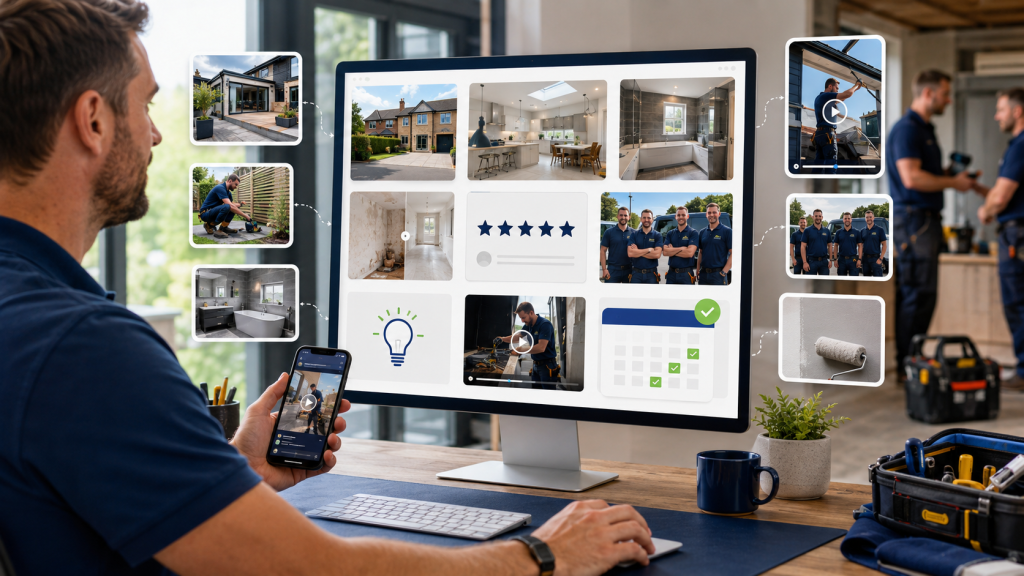
Project Presence UK manages the complete online presence of local businesses from £300 per month.
You simply send photographs and occasional videos from your working day into a WhatsApp group. We then:
- Organise your content
- Select and edit the photographs
- Write the captions
- Adapt posts for the relevant platforms
- Schedule two to three posts per week
- Create up to two edited reels per month
- Publish content across your social media accounts
- Update your Google Business Profile
- Monitor and respond to Google reviews
- Store previous content for quieter periods
We can also proactively prepare review graphics, business announcements, team posts, seasonal reminders and other relevant updates.
You concentrate on completing the work. We make sure people see it.
Contact Project Presence UK to tell us about your business and find out how the service works.