
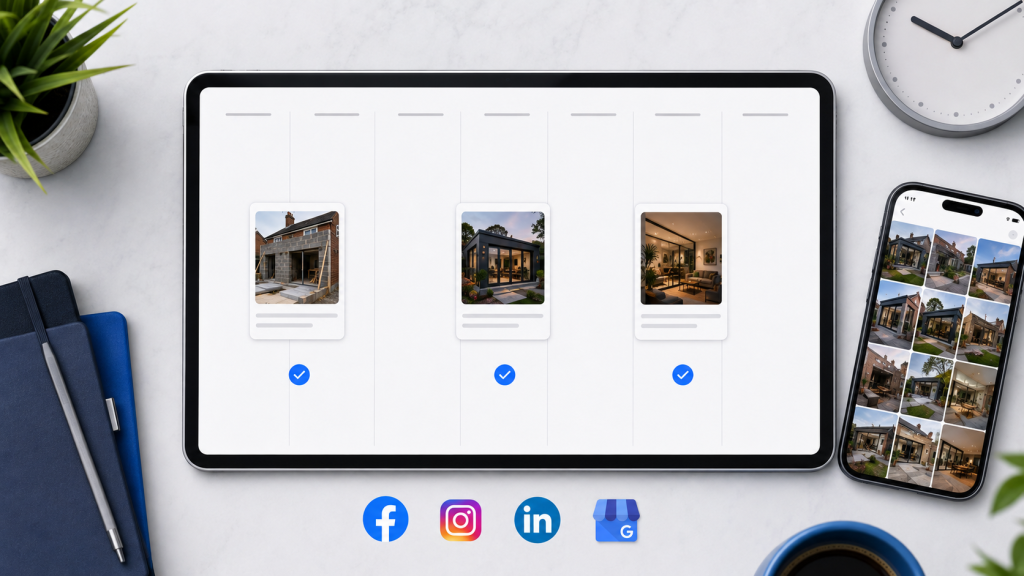
For most local businesses, posting on social media two to three times per week is a realistic and effective target.
This is normally frequent enough to keep your business visible, show potential customers that you are active and build a professional collection of recent work. It is also manageable without overwhelming your audience or forcing you to create content simply for the sake of posting.
However, the right posting schedule depends on the type of business, the platforms being used and how much useful content is available.
Is Two or Three Posts Per Week Enough?
For most tradespeople and local service businesses, two or three good posts each week will usually be more valuable than posting every day and then disappearing for several months.
A consistent schedule helps you:
- Show that the business is active and taking on work
- Build a portfolio of completed projects
- Keep your name in front of previous and potential customers
- Demonstrate your experience and professionalism
- Give people a reason to follow your business
- Keep your social media profiles looking current
- Provide Google with more recent information about the business
The important word is consistent.
Posting ten times during one busy week and then sharing nothing for three months can make the business appear inactive. A steady flow of relevant updates creates a much stronger impression.
How Often Should You Post on Each Platform?
You do not necessarily need to create completely different content for every platform. One completed project can be adapted and shared across several channels.
For most local businesses, two to three Facebook posts per week is a sensible target.
Facebook works particularly well for:
- Completed projects
- Before-and-after photographs
- Customer reviews
- Business announcements
- Meet-the-team content
- Seasonal reminders
- Local community updates
Posts should feel natural and conversational. They do not need to resemble highly polished advertisements.
Aim for approximately two to three feed posts per week, supported by Stories whenever you have quick updates to share.
Instagram is highly visual, making it particularly useful for trades, construction companies, garages, landscapers, roofers and other businesses with physical work to showcase.
Photographs do not need to be professionally taken. Clear pictures showing the finished result, progress or the people behind the business can all become useful content.
For a local business, one or two LinkedIn posts per week may be enough.
LinkedIn content can focus on:
- Larger or commercial projects
- Business milestones
- New contracts
- Recruitment
- Team achievements
- Industry news
- Partnerships and accreditations
The same project shared on Facebook can often be rewritten with a more business-focused angle for LinkedIn.
TikTok
TikTok depends more heavily on video. Posting one or two useful videos per week can be more realistic than trying to publish something every day.
Suitable video ideas include:
- Short project walkthroughs
- Before-and-after transformations
- Time-lapse footage
- A quick explanation from a team member
- Common customer questions
- Behind-the-scenes clips
Businesses should not feel pressured to follow every trend. Straightforward videos showing genuine work can be more relevant to potential customers.
X, Formerly Twitter
X generally moves faster than other platforms, so businesses using it may benefit from posting more frequently.
However, many local businesses will gain more value from prioritising Facebook, Instagram and Google Business Profile unless their customers, industry contacts or local organisations are particularly active on X.
Google Business Profile
Google Business Profile is not a traditional social media platform, but it is an important part of a local business’s online presence.
Businesses should regularly:
- Upload recent project photographs
- Add business updates
- Check that services and contact information are accurate
- Monitor new customer reviews
- Respond to reviews
- Update opening hours when necessary
Adding fresh photographs and keeping the profile complete helps potential customers see that the business is active and gives them more information before making contact.
Should You Post Every Day?
Most local businesses do not need to post every day.
Daily posting can work when a company has a dedicated content team, plenty of interesting material and an audience that expects frequent updates. For a busy tradesperson or small business owner, it can quickly become unrealistic.
The pressure to post daily often leads to:
- Repetitive content
- Rushed photographs
- Weak captions
- Irrelevant posts
- Long periods of inactivity after the initial enthusiasm disappears
It is better to publish two or three relevant posts every week for the whole year than to post daily for a fortnight and then stop.
What Should a Local Business Post About?
One of the main reasons businesses stop posting is because they believe they have run out of things to say.
In reality, ordinary business activity can provide plenty of useful content.
Ideas include:
- Recently completed work
- Before-and-after photographs
- Projects currently in progress
- Customer testimonials
- Google reviews
- Meet-the-team posts
- Company birthdays and anniversaries
- New equipment or vehicles
- Business announcements
- Helpful advice
- Common customer questions
- Industry developments
- Seasonal reminders
- Recruitment opportunities
- Accreditations and qualifications
- Areas the business covers
Not every post needs to sell something directly. Showing the people, experience and day-to-day work behind the business can help potential customers feel more confident about getting in touch.
One Project Can Produce Several Posts
A single project does not have to become just one social media update.
For example, a kitchen installation could provide:
- An initial photograph showing the old kitchen
- A progress update during the work
- Photographs of the completed installation
- A before-and-after comparison
- A customer testimonial
- A short video walkthrough
- A post explaining one part of the installation
- An update for the business’s Google profile
This allows the business to stay active without constantly needing completely new ideas.
What If the Business Is Having a Quiet Week?
Quiet periods are normal. This is why businesses should organise and retain their previous photographs and videos.
Older content can be reused when it is still relevant, particularly if:
- The original post did not reach many people
- The work demonstrates an important service
- The project took place in a key service area
- New followers may not have seen it
- The photographs can be presented from a different angle
A completed project could initially be shared as a general update and later reused to discuss the service, location, materials, customer feedback or problems that were solved.
Other content such as reviews, team introductions, advice and seasonal reminders can also fill gaps between project updates.
Do You Need Professional Photographs?
Professional photography can be valuable, but it is not required for every social media post.
For most local businesses, a clear smartphone photograph is enough. Try to:
- Clean the camera lens
- Take photographs in good lighting
- Keep the phone straight
- Remove unnecessary clutter where possible
- Take several angles
- Capture both landscape and portrait versions
- Photograph the work before, during and after completion
The photograph can then be cropped, adjusted and prepared for the relevant platform.
What matters most is developing the habit of recording the work. A photograph sitting in a phone gallery cannot help promote the business until it is shared.
Should the Same Post Be Used Everywhere?
The same core content can be used across multiple platforms, but the presentation should be adjusted.
For example:
- Facebook can use a conversational caption and website link
- Instagram can use a shorter caption and relevant hashtags
- LinkedIn can focus on the commercial value or project details
- TikTok can use a vertical video version
- Google Business Profile can provide a concise project update without unnecessary promotional wording
This saves time while ensuring that the content still feels appropriate for each audience.
A Realistic Weekly Posting Schedule
A simple schedule for a local business could look like this:
Monday: Recent project
Share photographs of recently completed work, including the service and general location.
Wednesday: Review or useful advice
Share a recent customer testimonial, answer a common question or provide a useful seasonal reminder.
Friday: Business update
Post a before-and-after comparison, team update, work-in-progress photograph or short video.
This provides variety without requiring daily content.
When Is the Best Time to Post?
There is no single posting time that works for every business.
A useful starting point is to schedule posts when customers are more likely to check their phones, such as:
- Early morning
- Lunchtime
- Early evening
The business can then review its platform insights to see when followers are most active.
However, the difference between posting consistently and not posting at all is normally much more important than finding the supposedly perfect minute to publish.
How Far in Advance Should Content Be Scheduled?
Preparing content one or two weeks in advance can make the process much easier.
Scheduling posts in batches allows businesses to:
- Maintain a consistent posting routine
- Check captions before publishing
- Adapt content for different platforms
- Prepare posts around holidays
- Avoid rushing to create something at the last minute
Immediate updates can still be shared when something is particularly timely, but most content does not need to be posted on the same day the photograph was taken.
What Is the Best Posting Frequency for a Local Business?
For most local businesses, a good starting point is:
- Two to three core posts per week
- Regular photographs added to Google Business Profile
- Occasional Stories and short videos when available
- Prompt responses to comments and customer reviews
- A consistent schedule maintained throughout the year
The objective is not to publish as much content as possible. It is to create a reliable, professional online presence that accurately reflects the quality of the business.
Need Help Keeping Your Business Active Online?
Project Presence UK manages the complete online presence of local businesses from £300 per month.
You simply send photographs and occasional videos of your work into a WhatsApp group. We edit the content, write the captions and schedule it across Facebook, Instagram, LinkedIn, TikTok, X and Google Business Profile where appropriate.
The service also includes Google Business Profile optimisation, review monitoring, review responses, content organisation and up to two edited reels per month.
You can concentrate on running the business while we make sure people continue to see the work you are doing.
Contact Project Presence UK to tell us about your business and find out how the service works.